How Occupational Therapy in Lombard, IL Can Help

  • Rooms for individualized 1:1 therapy
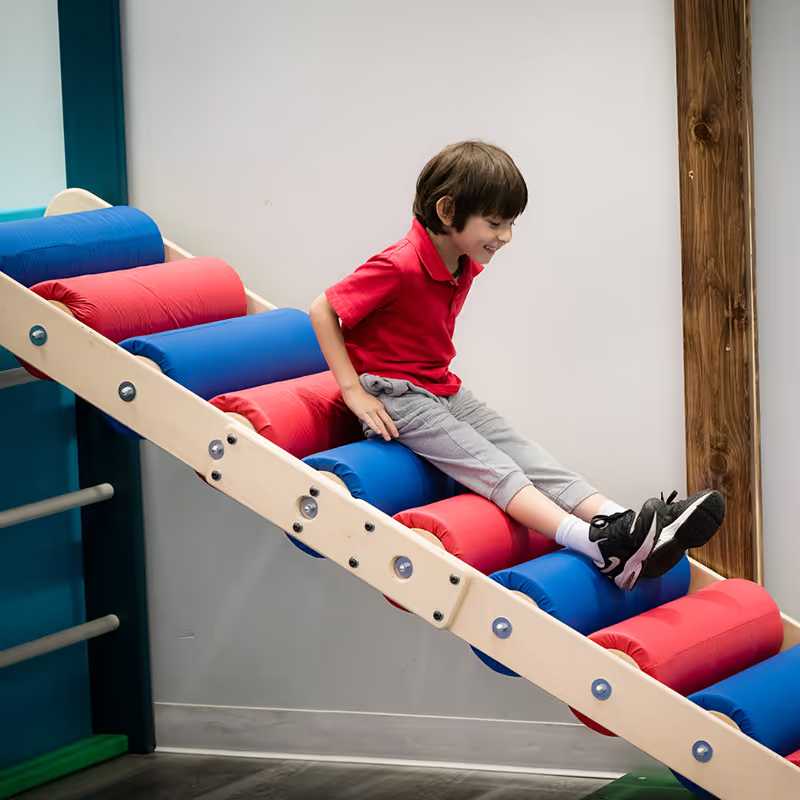
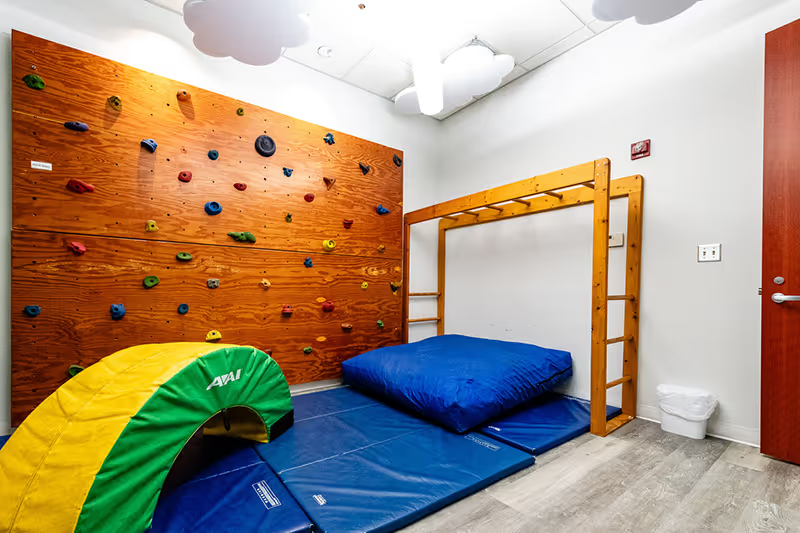
  • Gyms that feature a climber play structure, swings, rock wall, and monkey bars to target strength, balance, coordination, and sensory processing in an environment of play.
  • Additional special spaces include a feeding room, classroom-style learning rooms, and sensory spaces
  • Classrooms provide clients with readiness for their own school journey, in addition to opportunities for socialization and group learning.

How Occupational Therapy in Lombard, IL Can Help

Occupational therapy (OT) can play a vital role in supporting children's development, enabling them to gain confidence and independence in everyday activities. Our team of occupational therapists works with children across multiple areas:

  • Fine Motor Skills: Strengthening hand-eye coordination and hand strength for activities like writing, buttoning, and cutting
  • Gross Motor Skills: Building core strength and coordination to support walking, running, jumping, and other movements
  • Sensory Processing: Helping children interpret and respond to sensory input (like touch, sounds, and movement) in a way that feels comfortable
  • Self-Care Skills: Supporting independence in daily tasks such as dressing, feeding, and grooming
  • Social and Play Skills: Encouraging positive interactions, turn-taking, and cooperative play with peers
  • Emotional Regulation: Teaching strategies to manage frustration, anxiety, and other emotions effectively

Our compassionate team creates fun and meaningful activities to help each child succeed in their goals, supporting their development in a warm, inclusive environment.
Request an Assessment
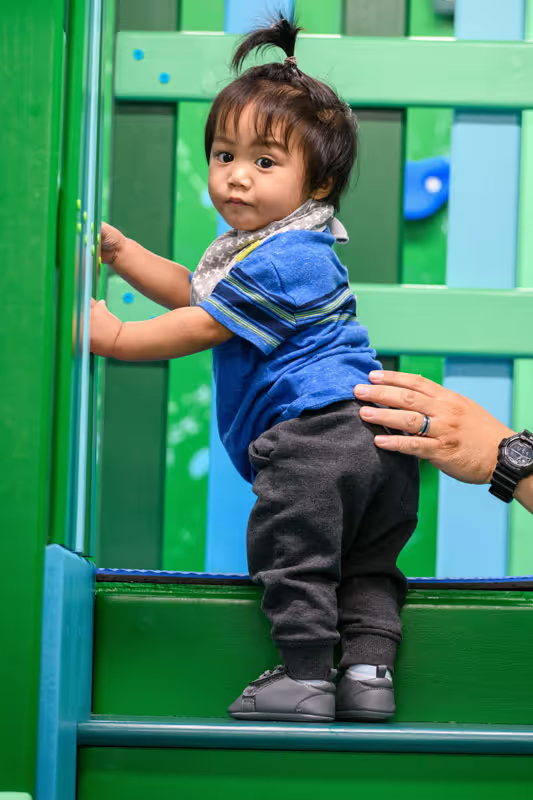
Toddler climbing on play gym at therapy center

How Occupational Therapy in Lombard, IL Can Help

Occupational therapy (OT) can play a vital role in supporting children's development, enabling them to gain confidence and independence in everyday activities. Our team of occupational therapists works with children across multiple areas:

  • Fine Motor Skills: Strengthening hand-eye coordination and hand strength for activities like writing, buttoning, and cutting
  • Gross Motor Skills: Building core strength and coordination to support walking, running, jumping, and other movements
  • Sensory Processing: Helping children interpret and respond to sensory input (like touch, sounds, and movement) in a way that feels comfortable
  • Self-Care Skills: Supporting independence in daily tasks such as dressing, feeding, and grooming
  • Social and Play Skills: Encouraging positive interactions, turn-taking, and cooperative play with peers
  • Emotional Regulation: Teaching strategies to manage frustration, anxiety, and other emotions effectively

Our compassionate team creates fun and meaningful activities to help each child succeed in their goals, supporting their development in a warm, inclusive environment.

Request an Assessment
Small child at pediatric therapy working on fine motor skills

Speech Developmental Milestones: Birth to 18 Months

If you're worried whether your child is meeting key developmental milestones, our speech therapists are here to help. Evaluations and services are covered by most insurance providers.

Even if you have just one of the concerns on this list, an evaluation can help!

Contact us to learn more about our services and determine whether 1:1 support is needed to facilitate your child's growth and development.

Request an Appointment
Birth to 3 Months
  • Small arrow icon to denote a list item
    Does not turn to or pay attention to sounds
  • Small arrow icon to denote a list item
    Does not coo or make sounds like ooooo, aahh, and mmmmm
4-6 Months
  • Small arrow icon to denote a list item
    Does not giggle or laugh
  • Small arrow icon to denote a list item
    Does not look at or follow objects with their eyes
  • Small arrow icon to denote a list item
    Does not vocalize during play or with objects in mouth
7-9 Months
  • Small arrow icon to denote a list item
    Does not respond when you call their name
  • Small arrow icon to denote a list item
    Makes no gestures or only a few gestures, like reaching, waving, or pointing
  • Small arrow icon to denote a list item
    Does not recognize names of some people and objects
10-12 Months
  • Small arrow icon to denote a list item
    Does not respond to simple words and phrases
  • Small arrow icon to denote a list item
    Does not say one or two word phrases (e.g. mama, dada, hi, bye)
  • Small arrow icon to denote a list item
    Does not point, wave, show, or give objects
  • Small arrow icon to denote a list item
    Does not imitate or initiate gestures for engaging in social interactions and playing games
13-18 Months
  • Small arrow icon to denote a list item
    Does not follow directions (e.g. give me the ball, show me your nose)
  • Small arrow icon to denote a list item
    Does not shake head for "no" or nod head for "yes"
  • Small arrow icon to denote a list item
    Cannot identify one or more body parts
  • Small arrow icon to denote a list item
    Does not point to make requests, comment, or get information
  • Small arrow icon to denote a list item
    Does not use a combination of long strings of sounds, syllables, and real words
  • Small arrow icon to denote a list item
    Does not use or understand at least 50 words

Occupational Therapy Developmental Milestones: Birth to 18 Months

If you're worried whether your child is meeting key developmental milestones, our occupational therapists are here to help. Evaluations and services are covered by most insurance providers.

Even if you have just one of the concerns on this list, an evaluation can help!

Contact us to learn more about our services and determine whether 1:1 support is needed to facilitate your child's growth and development.

Request an Appointment
4-5 Months
  • Small arrow icon to denote a list item
    Becomes very upset when moved and is frequently irritable for no reason
  • Small arrow icon to denote a list item
    Hands remain closed or fisted most of the time
  • Small arrow icon to denote a list item
    Does not reach for objects
  • Small arrow icon to denote a list item
    Does not follow an object with their eyes
6-7 Months
  • Small arrow icon to denote a list item
    Does not support self on forearms with head in midline
  • Small arrow icon to denote a list item
    Does not bring hands or objects to mouth
  • Small arrow icon to denote a list item
    Does not have good head control
8-10 Months
  • Small arrow icon to denote a list item
    Does not transfer an object from one hand to another
  • Small arrow icon to denote a list item
    Does not actively grasp large objects or finger foods when placed in front of them
  • Small arrow icon to denote a list item
    Is not beginning to pick up small objects
  • Small arrow icon to denote a list item
    Is not beginning to show finger isolation
  • Small arrow icon to denote a list item
    Is excessively upset about being moved, dressed, changed, or bathed
12-14 Months
  • Small arrow icon to denote a list item
    Is not interested in age-appropriate toys
  • Small arrow icon to denote a list item
    Is excessively upset by loud noises
  • Small arrow icon to denote a list item
    Is not able to pick up small objects, such as a cheerio, with the tip of the thumb and tip of the index finger
  • Small arrow icon to denote a list item
    Is not able to voluntarily release an object from hand
15-18 Months
  • Small arrow icon to denote a list item
    Is unable to complete a simple shape puzzle
  • Small arrow icon to denote a list item
    Is unable to stack 2-4 blocks
  • Small arrow icon to denote a list item
    Is unable to identify and point to body parts
  • Small arrow icon to denote a list item
    Does not engage in pretend play

How Occupational Therapy in Lombard, IL Can Help

Occupational therapy (OT) can play a vital role in supporting children's development, enabling them to gain confidence and independence in everyday activities. Our team of occupational therapists works with children across multiple areas:

  • Fine Motor Skills: Strengthening hand-eye coordination and hand strength for activities like writing, buttoning, and cutting
  • Gross Motor Skills: Building core strength and coordination to support walking, running, jumping, and other movements
  • Sensory Processing: Helping children interpret and respond to sensory input (like touch, sounds, and movement) in a way that feels comfortable
  • Self-Care Skills: Supporting independence in daily tasks such as dressing, feeding, and grooming
  • Social and Play Skills: Encouraging positive interactions, turn-taking, and cooperative play with peers
  • Emotional Regulation: Teaching strategies to manage frustration, anxiety, and other emotions effectively

Our compassionate team creates fun and meaningful activities to help each child succeed in their goals, supporting their development in a warm, inclusive environment.

Request an Assessment
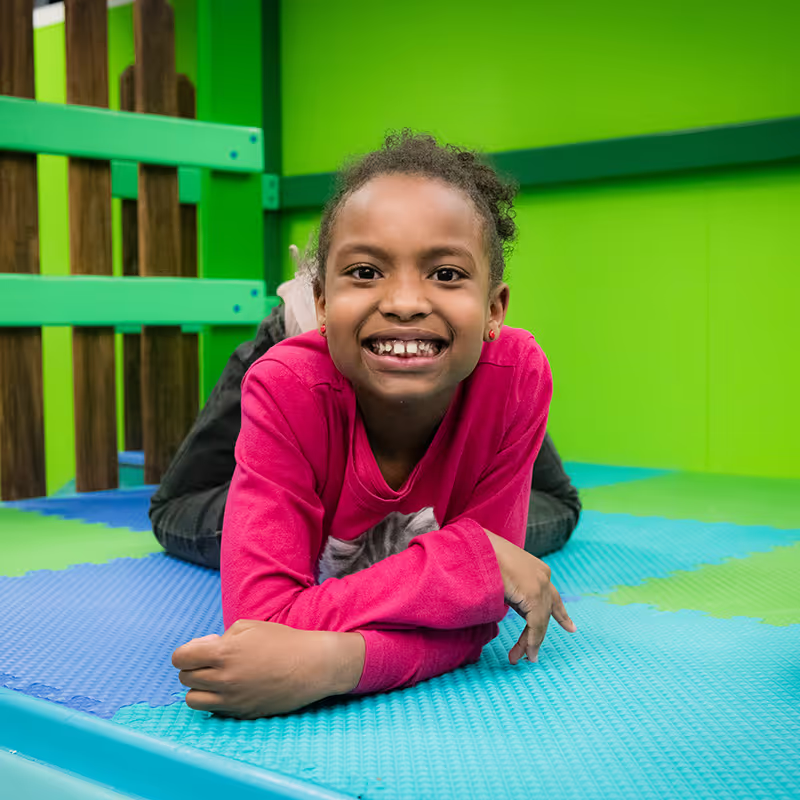
A child smiling while lying down and enjoying the gym space at North Shore Pediatric Therapy in Evanston

Frequently Asked Questions about Pediatric Occupational Therapy in Lombard, IL

Frequently Asked Questions about Pediatric Occupational Therapy in Lombard, IL

Small child at pediatric therapy working on fine motor skills

Frequently Asked Questions about Pediatric Occupational Therapy in Lombard, IL

Request an Assessment

Are Early Intervention Services at North Shore Pediatric Therapy affiliated with the Illinois Early Intervention Program?

Our early intervention services are offered independently, with no affiliation with the Illinois Early Intervention Program. However, our therapists have deep experience working with children of all ages, especially those 3 years old and younger. Our private practice provides a range of therapies, including speech, occupational, physical, mental health, Applied Behavior Analysis (ABA), and autism or comprehensive neuropsychological testing, tailored to meet the unique needs of each child.

While both programs aim to support children's development, there are a few important differences. You should make the most appropriate and reasonable decision for your family and child’s current situation.

 
That's us!
Blossom illustration with the words North Shore Pediatric Therapy
Illinois Early Intervention
How quickly are services available?
We can start therapy right away during the morning and early afternoon times (8 AM – 3 PM) with no wait lists at almost all North Shore Pediatric Therapy locations.
Depending on your geography, there could be longer waiting lists for evaluations and starting EI services.
Who qualifies for services?
Here is a message to help explain the content.
Open to all children, and therapies are personalized based on your child’s needs. For insurance reimbursement, some clients may require a referral and diagnosis, which we’ll work with you to
Children may not always qualify for EI services if they are not determined to have a developmental delay of 30% or more in certain areas of development.
If autism is suspected, who can diagnose this?
We have an in-house neuropsychology team dedicated to providing convenient autism assessments to families who suspect or have been referred to for autism testing. A formal diagnosis can open paths to additional therapies, support, and accommodations for a child. Like other therapies, testing is usually covered by insurance.
EI does not provide formal autism diagnoses. EI focuses on developmental assessments and providing therapy services to support areas of delay. If a formal autism diagnosis is needed, families are typically referred to a specialist, such as a neuropsychologist or developmental pediatrician, outside of the EI system.
What is the cost of services?
The cost of services depends on your insurance plan, just like a visit to any other medical specialist.

Your plan’s deductible (how much you need to pay on your own before insurance begins covering services), copays (a daily or per service fee that some insurances charge), and coinsurance (how much of the ongoing costs are covered after meeting your deductible) all impact the cost of therapy.
EI evaluations and coordination of services are free, but therapy services are not. EI sets a family participation fee based on your family’s income, size, and any significant out-of-pocket medical expenses. In many cases, if your child is covered under a private insurance plan, you are required to use your insurance benefits to help cover the costs of EI services.
Where does therapy happen?
Therapy happens in a center with gyms, play spaces, tools, and special equipment to help your child.

A center environment means that therapists with different specialties can collaborate on the same case and can provide socialization opportunities with other clients during
EI therapists come to your home or work with your child in community settings, which can be very convenient for families.
How long do services last?
Therapy can continue as long as your child needs it, even beyond age 3. You have more control over how long your child receives services, including transitioning from one service to another depending on your child’s unique needs.
Services are reviewed regularly and continue only if your child still qualifies. Services end when your child turns 3, with support to transition to school programs.

Getting to Our Elmhurst, IL Center from Lombard, IL

Map location icon

We are located in downton Elmhurst, just steps from the Elmhurst Metra station. There is ample street parking along Addison Ave.

Who We Serve

Our Elmhurst ABA Therapy & Pediatric Therapy center proudly serves families in Elmhurst and the surrounding areas. We're also conveniently located within a 10-mile radius of many nearby communities, including: Oak Brook, Villa Park, Lombard, Addison, Hinsdale, and Downers Grove.

No matter where you're coming from, our team is here to support your child's growth and well-being.

Hours of Operation

Monday to Friday: 8:00 am to 7:00 pm
Saturday: 8:00 am to 3:00 pm
Sunday: Closed

Getting here

Getting to Our Elmhurst, IL Center from Lombard, IL

Gracent Pediatric Therapy — Elmhurst

121 N Addison Ave, Elmhurst, IL 60126

We are located in downton Elmhurst, just steps from the Elmhurst Metra station. There is ample street parking along Addison Ave.

Hours:

Monday to Friday: 8:00 am to 7:00 pm
Saturday: 8:00 am to 3:00 pm
Sunday: Closed

Open in Google Maps →
Families, in their words

What families say

There are no words that will help me explain how grateful my family and I are with this facility. Our son goes to the Elmhurst location and every single one of the therapist are absolutely amazing and so exceptional with our son. Maddie, Amy to name a few are amazing at what they do. We are happy our son loves coming here. We highly recommend this location for any parents looking into ABA Therapy.

— A local family

So grateful for this place my son has come along way from nonverbal to actually talking. His support team is so great and they love him so much. Like my son says "i love it aba."

★★★★★

I'm so very grateful for the amount of love and support they give to my son am a day to day basis.

★★★★★

Some of the most friendliest and knowledgeable staff I have ever met! Smiling faces all around from therapist to kiddos! You can see how much they genuinely care and love what they do! Could not recommend them more than this!

★★★★★

Contact us to get started

  • 1
    Submit an inquiry form
    Completing this secure form helps us understand how we can serve you.
  • 2
    We'll reach out to you!
    One of our dedicated team members will connect with you to discuss services, your insurance benefits, and your family’s needs.
  • 3
    Paperwork & insurance
    We'll review and confirm your insurance benefits, and we'll work with you to gather additional paperwork required.
  • 4
    Treatment personalization
    We'll schedule an assessment date for your child with one of our clinicians. This assessment will serve as the basis for your child’s personalized treatment plan. After, we'll meet to discuss recommendations and your child’s treatment plan and start date.
  • 5
    Start making progress!
    We will greet and welcome your child to our warm and supportive environment where our staff will provide 1-on-1 care to meet our treatment goals.
By submitting this form, you consent to receive SMS messages, emails, and phone calls from North Shore Pediatric Therapy at the number and email address provided. Msg & data rates may apply. Msg frequency varies. Unsubscribe by replying STOP. Phone numbers will not be shared with third parties. Privacy Policy & Terms.